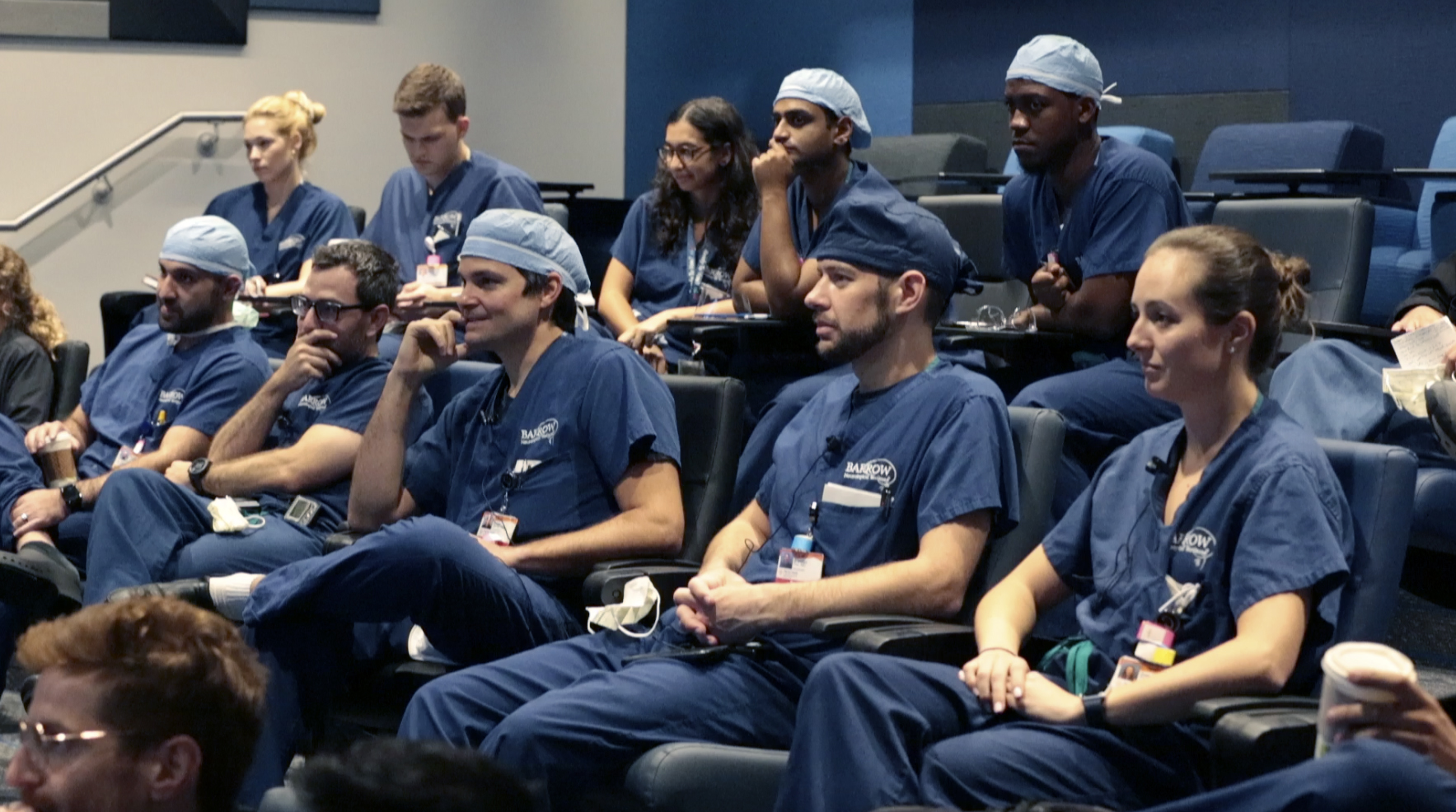
Education is one of Barrow Neurological Institute‘s core missions alongside patient care and research, resulting in both exceptionally trained physicians and better patient outcomes.
By enriching the next generation of neurologists and neurosurgeons, Barrow helps improve care for patients today while advancing the future of neuroscience for decades to come. Every resident and fellow who graduates from Barrow carries its expertise to hospitals, academic medical centers, and communities around the world, expanding access to vital neurological care.
This commitment to education is woven into everything Barrow does. As one of the nation’s premier teaching hospitals—ranked #13 among America’s top major teaching hospitals by Fortune—Barrow combines world-class clinical care, cutting-edge research, and hands-on medical education in an environment where innovation can thrive.
Donor support makes this mission possible. Generous Barrow Neurological Foundation donors help future physician-leaders gain the knowledge, experience, and resources they need to transform neurological care and improve lives.
What Does Residency Training Look Like at Barrow?
The residency programs at Barrow provide physicians with the rigorous clinical training, specialized expertise, and research foundation needed to become leaders in neurological care. Barrow offers residency programs in neurology, neurosurgery, neurological physical therapy, neuropsychology, and rehabilitation psychology.
The four-year Neurology Residency Program offers broad exposure to the full spectrum of neurological diseases, preparing residents to diagnose and treat both common and highly complex conditions, while the seven-year Neurosurgery Residency Program equips future neurosurgeons to care for challenging neurological disorders through progressive surgical responsibility and intensive subspecialty training.
Across both programs, residents learn alongside internationally recognized faculty in inpatient and outpatient settings, operating rooms, multidisciplinary conferences, simulation experiences, anatomy laboratories, and research environments. They gain experience caring for patients with conditions ranging from stroke, epilepsy, multiple sclerosis, Alzheimer’s disease, and movement disorders to brain tumors, cerebrovascular disease, spine disorders, trauma, and pediatric neurosurgical conditions.
Supported by expert mentorship, advanced technologies, and a culture that encourages scientific discovery, Barrow residents develop the clinical expertise, technical skill, critical thinking, and compassion needed to advance the field and deliver exceptional patient care.
How Does Philanthropy Support Resident Education and Training?
Through Barrow Neurological Foundation, residents are empowered to become active participants in advancing the field of neuroscience. Philanthropic support allows residents to pursue innovative research ideas through competitive grant funding, encouraging them to investigate questions and ideas that could ultimately improve patient outcomes.
Donor support also enhances educational experiences through programs and facilities such as the Thurston Innovation Center, where new technologies and ideas can be explored, and the Spine Virtual Reality Laboratory, which allows residents to practice complex surgical techniques using immersive simulation before even entering the operating room.
These experiences enrich residency training while helping young physicians and surgeons build the confidence and technical skills that shape lifelong careers in academic medicine and clinical leadership.
Fellowship Training and Subspecialty Expertise at Barrow
After residency, many physicians choose to pursue fellowship training to gain advanced expertise in a specific area of neuroscience.
Fellowships provide intensive, specialized education that allows physicians to master complex diseases, advanced procedures, and cutting-edge research within a focused discipline. Barrow offers numerous neurology and neurosurgery fellowship programs spanning virtually every major neuroscience subspecialty, including epilepsy, vascular neurology (stroke), neurocritical care, movement disorders, multiple sclerosis and neuroimmunology, headache medicine, behavioral neurology, neuroimaging, functional neurosurgery, cerebrovascular surgery, spine surgery, skull base surgery, and many others.
Working alongside internationally recognized faculty, fellows contribute to clinical care, research, education, and innovation while refining expertise that will define the next stage of their careers.
How Does Philanthropy Support Fellowship Training?
Many of the fellowship opportunities at Barrow exist because of generous philanthropic support.
Donor-funded fellowships help attract exceptional physicians from around the world while allowing them to receive advanced training under internationally recognized mentors.
These include:
- Dan Crachiolo and Pam Grant Behavioral Neurology and Neuropsychiatry Fellowship, supporting future leaders in Alzheimer’s disease and memory disorders.
- Solheim-Aiken Epilepsy and Clinical Neurophysiology Fellowship within the Barrow Epilepsy Center.
- Headache Medicine Fellowship in the Lewis Headache Center.
- Sy Syms Foundation Fellowship for Movement Disorders in the Muhammad Ali Parkinson Center.
- Multiple Sclerosis and Neuroimmunology Fellowship in the Barrow Multiple Sclerosis Program.
- Woodlyn T. Kendrick Vascular Neurology Fellowship in the Petznick Stroke Center.
- Neuroimaging Fellowship in the Barrow Neuroimaging Innovation Center.
Graduates consistently describe these donor-supported experiences as transformative.
Reflecting on his training as the Solheim-Aiken Epilepsy and Clinical Neurophysiology Fellow, John Eaton, MD, shared:
“Each of my Barrow mentors brought their own incredible skills and unique approaches. Witnessing their diverse perspectives helped shape my own philosophy as a physician and researcher. Moreover, Barrow’s high volume of patients with some of the most complex epilepsy cases has prepared me well for the next step in my career journey.”
Holly Laub, DO, a graduate of the Sy Syms Foundation Fellowship for Movement Disorders, emphasized the personal and professional growth made possible through philanthropy:
“I am incredibly grateful for this fellowship opportunity. I have further developed my diagnostic skills, expanded my management options, and enhanced my bedside manner. I feel well-prepared to begin my career as a movement disorders neurologist.”
For Sarah Ahmad, MD, the Woodlyn T. Kendrick Vascular Neurology Fellowship shaped an entirely new career path:
“My fellowship at Barrow has significantly altered my career trajectory. My mentors believed in my potential and provided excellent examples of what it means to be a clinician-educator and researcher in academic medicine.”
These stories illustrate how philanthropy invests not only in individual physicians but also in the countless patients they will care for throughout their careers.
How Donor Support Strengthens Neuroscience Education
Every gift helps build the future of neurological care.
Philanthropy supports resident and fellowship education by funding innovative research projects, advanced simulation technologies, educational programming, mentorship opportunities, and pipeline development that attracts exceptional physician trainees from around the world.
The impact is measurable.
In 2025, Barrow trained 33 neurology residents and 8 neurology fellows, while maintaining a 95% neurology board pass rate over the past three years.
The Institute also trained 28 neurosurgery residents and 4 neurosurgery fellows, and its Neurosurgery Residency Program was ranked #1 on Doximity’s list of top neurosurgery residency programs for two consecutive years.
Combined with Barrow’s recognition as one of America’s top teaching hospitals, these achievements reflect a culture where education, research, and patient care strengthen one another every day.
When donors invest in neuroscience education, they’re helping prepare the physicians who will provide care to future generations, pioneer new discoveries in neuroscience, and ultimately improve neurological outcomes around the globe.
Investing in Tomorrow’s Neuroscience Leaders
Patients benefit when physicians receive exceptional training. Research advances when curious physician-scientists are given opportunities to explore new ideas. And in the same way, entire communities benefit when physician leaders carry their knowledge beyond the walls of Barrow.
Through philanthropy, supporters become partners in this mission—helping educate future neurologists and neurosurgeons while accelerating discoveries that tangibly improve lives.