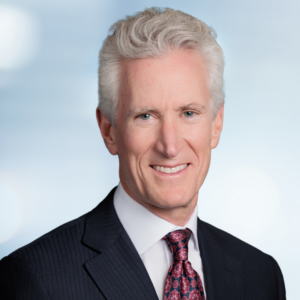
Michael T. Lawton, MD
President and Chief Executive Officer,
Barrow Neurological Institute
Michael T. Lawton, MD, is the president and chief executive officer of Barrow Neurological Institute, as well as its chairman of the Department of Neurological Surgery and the Robert F. Spetzler Endowed Chair in Neurosciences. Additionally, he is the chief of vascular and skull base neurosurgery at Barrow. He specializes in the surgical treatment of aneurysms, arteriovenous malformations, arteriovenous fistulas, cavernous malformations, and cerebral revascularization, including carotid endarterectomy. As the leader of the largest cerebrovascular center in the country, he has experience in surgically treating more than 5,400 brain aneurysms and over 1200 AVMs. He also practices skull base tumor surgery and is trained in the endovascular treatment of aneurysms.
Dr. Lawton co-directs and conducts his research at the Barrow Aneurysm and AVM Research Center (BAARC), a collaborative research group funded by grants from the National Institutes of Health that investigates the physiology of cerebral circulation and the pathophysiology of vascular malformations. His basic science investigations focus on the formation, underlying genetics, and rupture of brain AFVMs, as well as the hemodynamics, rupture, and computational modeling of brain aneurysms. His clinical investigations study the anatomy of microsurgical approaches to vascular lesions and the outcomes of aneurysm, AVM, and bypass surgery. He is the principal investigator of a NIH U54 grant and program director of the Brain Vascular Malformation Consortium (BVMC), a multicenter group studying malformations associated with hereditary hemorrhagic telangiectasia, cavernous malformations, and Sturge-Weber syndrome.
He has published over 1,000 peer-reviewed articles, over 100 book chapters, and eight textbooks, including Seven AVMs: Tenets and Techniques for Resection, Seven Bypasses: Tenets and Techniques for Revascularization, and Seven Aneurysms: Tenets and Techniques for Clipping, which has won numerous awards and sold more copies than Yasargil’s Microneurosurgery. He recently published the fourth book in the Seven tetralogy, Seven Cavernomas: Tenets and Techniques for Resection. Dr. Lawton’s accolades include the Young Neurosurgeon Award from the World Federation of Neurological Societies, the Harold Rosegay Teaching Award, the Diane Ralston Clinical and Basic Science Teaching Award, BNI Neurosurgery Teaching Awards, an Impact Award as Exceptional Innovator from the Greater Phoenix Chamber, the Dacey Medal for outstanding cerebrovascular research, and the Cushing Award for Technical Excellence and Innovation from the American Association of Neurological Surgeons. He has given over 1200 invited lectures nationally and internationally, including visiting professorships at over 60 neurosurgical institutions. He has been active in resident teaching, directing the CNS Anatomy Course for Senior Residents, co-directing the AANS Vascular Skills Course, and directing industry-sponsored anatomy courses. He sponsors an observership in vascular neurosurgery that has hosted more the 600 neurosurgeons and residents nationally and internationally. He co-founded Mission:BRAIN, a teaching mission to raise the level of neurosurgery practiced in developing countries, and has conducted eight missions in Mexico, the Philippines, and Peru.