Grant funding is paramount to advancing neuroscience research, serving as a catalyst for transforming novel hypotheses into real-world clinical progression. It enables investigators to acquire critical resources, conduct innovative studies, and pursue high-risk, high-reward concepts, all of which are vital for navigating the complexities inherent in neuroscience research.
Neuroscience Grant Funding Basics
The Grants Committee of Barrow Neurological Foundation is committed to maintaining Barrow Neurological Institute’s rigorous standards and criteria for funding research. It awards grants for transformative work that not only expands scientific understanding but also builds a strong foundation for future discovery and clinical impact. Through a rigorous, competitive review process, the Committee provides critical funding to investigators across diverse career stages—from seasoned physicians and scientists to postdoctoral fellows and residents—underscoring a comprehensive commitment to research excellence.
Grants are awarded primarily through three funding mechanisms:
● Start-Up Packages: These packages are vital for recruiting and retaining top talent, fostering innovation, and achieving sustained impact. They provide the necessary resources (lab equipment, space, and personnel) for researchers to launch their programs and to sustain their activities while applying for external grants.
● Seed Funding: This initial research grant funding enables researchers to obtain preliminary, proof-of-concept data necessary to apply for larger external grants. It also allows them to test high-risk, high-reward ideas that otherwise would not be funded by external agencies such as the National Institutes of Health (NIH).
● Unrestricted Funding: Unrestricted funds provide Barrow with the flexibility to meet its most critical needs at any given time and to support research that can directly benefit patients.
Impact of Donations on Advancing Research
The importance of philanthropy in sustaining and advancing neuroscience research cannot be understated. Last year alone, the Foundation funded over $2.6 million in start-up package support and $2.4 million to support 16 research projects across a variety of neurological conditions. These high-impact projects included:
● The impact of microplastics in the brain on stroke outcomes
● Investigating specific inhibitor drugs as a potential therapeutic option for meningiomas – the most common brain tumor
● Investigating specific proteins that change after a traumatic brain injury and how those changes correlate to the extent of brain injury and patient outcomes
● Using data science to correlate temperature and air pollution levels in specific regions with the risk of Alzheimer’s disease
● Using ultra-high-resolution MRI and novel computer algorithms to define subtle changes in the brain that lead to seizures in epilepsy
Philanthropic Impact Over Time
● Start-Up Packages: Over the past 5 years, the Foundation has awarded 8 start-up packages. These packages have generated $19.3 million in funding from external agencies.
● Research Projects: Over the past 5 years, the Foundation has awarded $11.3 million to support 102 individual research projects.
● Overall Research: Over the past 4 years, investigators across Barrow have received $115 million in external research funding.
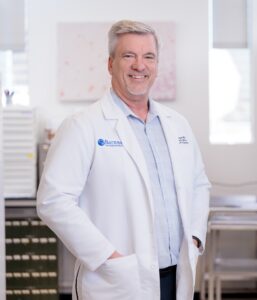
“Having a Foundation that supports internal grants that provide seed funding and start-up funding is crucial to moving ideas forward and generating data to get larger external grants as rapidly as possible. These grants are a cornerstone of success for research at Barrow.”
-Robert Bowser, PhD, Chief Scientific Officer, Barrow Neurological Institute
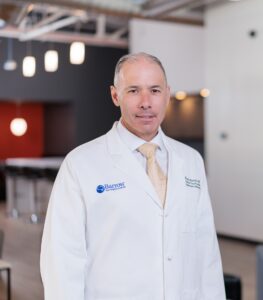 “Neurology department reputations are highly dependent on their investigator-initiated research portfolios. The Foundation’s Grants Committee provides the funding we need to generate preliminary data and develop a robust extramural grant portfolio of impactful research.”
-Brad A. Racette, MD, FAAN, Chair of Neurology and Senior Vice President, Barrow Neurological Institute
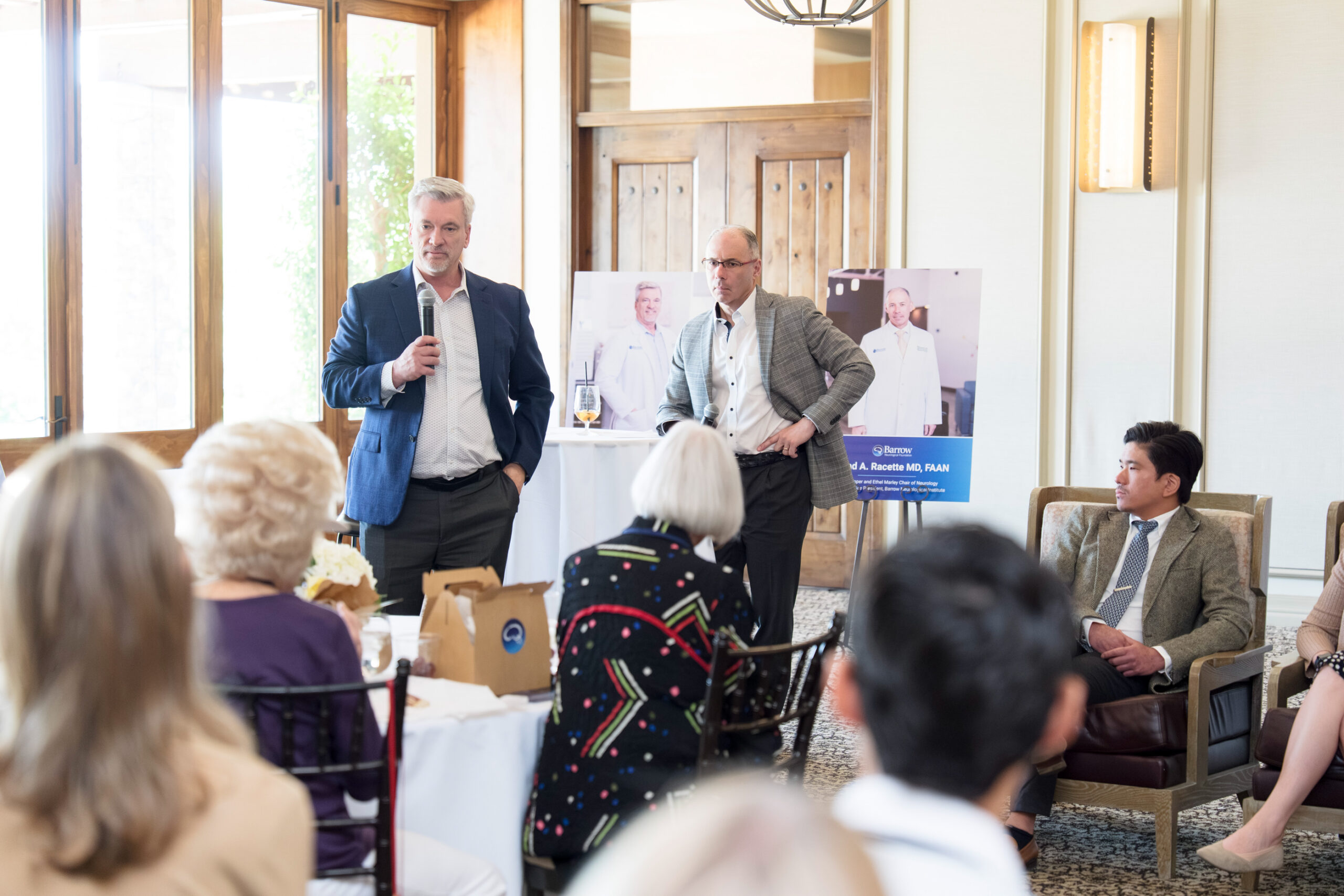
Inaugural Grants Research Symposium
In April 2026, the Grants Committee of Barrow Neurological Foundation held its inaugural Research Symposium. The event featured an interactive panel discussion moderated by Chief Scientific Officer Robert Bowser, PhD, and Chair of Neurology Brad Racette, MD, FAAN. Our panelists—Andrew Yang, MD, MS; Ashley Stokes, PhD; David Medina, PhD; and Ruchira Jha, MD, MSc—shared how Foundation grants helped them launch independent research programs, secure external grants, and pursue novel ideas that traditional funding can’t support.
It was a powerful reminder of how philanthropy fuels scientific breakthroughs, empowers talent, and transforms bold ideas into meaningful clinical impact.
Meet the Research Symposium Panelists
Andrew Yang, MD, MS
A neurosurgeon-scientist and Director of Epilepsy Surgery at Barrow. His research lab studies how the brain coordinates neural activity across regions to support mental abilities, such as multitasking and emotion regulation. This work relies on direct recordings from the human brain, made possible by his patients’ selfless participation during neurosurgical care. His long-term goal is to guide next-generation brain stimulation therapies for complex cognitive and psychiatric disorders.
Research Highlights:
- Recently completed an NIH K12 grant investigating the mechanisms of deep brain stimulation (DBS) for drug-resistant epilepsy
- Awarded an NIH R61 grant for a multi-institutional study investigating how networks of neurons in the brain work together to enable abstract reasoning—learning from similar examples and generalization
Grant Support: Start-up package of $2.8 million awarded in FY24
Ashley Stokes, PhD
An Associate Professor in the Barrow Neuroimaging Innovation Center. Her expertise includes developing, validating, and translating advanced MRI methods to support earlier diagnosis and improved disease monitoring across neurodegenerative and neurological conditions, including Alzheimer’s disease and other dementias, Parkinson’s disease, multiple sclerosis, traumatic brain injury, and brain tumors.
Research Highlights:
- Principal investigator of several federal- and state-funded studies using advanced quantitative imaging to improve our understanding of neurological diseases
- Research aims to turn cutting-edge imaging methods into practical tools that support earlier diagnosis, more personalized treatment decisions, and improved clinical care
Grant Support: Start-up package of $1.4 million awarded in FY19 – 44% of package utilized
David Medina, PhD
A Research Assistant Professor of Translational Neuroscience. His work focuses on identifying molecular mechanisms underlying neurodegenerative and neuromuscular diseases and developing therapeutic strategies to target these pathways. He aims to advance the development of disease-modifying treatments for conditions such as ALS, Alzheimer’s, and related dementias.
Research Highlights:
- Received a Therapeutic Idea Award from the Department of War to test the FDA-approved small molecule (m6A) as a potential therapy for ALS, generating preclinical data to support clinical translation
- Studying how changes in RNA regulation may drive neurodegeneration to identify new targets for therapy and early detection
Grant Support: Funding for research projects – received $221K for two projects in FY26
Ruchira Jha, MD, MSc
The Atkinson Chair for Research, division chief of Neurocritical Care, medical director of the Neurointensive Care Unit, and director of the Jha Laboratory, which uses a translational approach to develop individualized targets against secondary injuries, such as brain swelling, to improve outcomes after Acute Brain Injury (ABI). Her lab focuses on multiple types of ABI seen in the neuro-critical care unit, including severe brain trauma, bleeding caused by aneurysm rupture, and different types of stroke.
Research Highlights:
- Principal investigator for two NIH-funded studies, several Chuck Noll Foundation-funded studies, and a Co-PI on a Department of War study
- Translational studies aim to establish a molecular foundation for precision medicine by developing biomarkers and targeted treatments for ABI
Grant Support: Start-up package of $1.9 million awarded in FY21 – 61% of package utilized
Thanks to the generosity of Barrow Neurological Foundation donors, bold ideas are explored, early-career scientists are mentored, and promising breakthroughs move closer to real-world impact. Every contribution, no matter the size, is an investment in a future where neurological conditions are better understood, treated, and, ultimately, overcome.
Join us in advancing this critical research mission by making a donation today.